Let’s cut through the marketing fluff for a second. You’re not picking out patio furniture. You’re specifying the literal foundation for a revenue-generating space—a restaurant patio packed with diners, a hotel pool deck crowded with guests, a bustling rooftop bar. Your choice in commercial decking boards isn’t an aesthetic preference; it’s a capital investment, a liability calculation, and a direct line to your operational sanity. Get it wrong, and you’re signing up for a recurring nightmare of repairs, safety hazards, and angry stakeholders. Get it right, and the deck becomes a silent, dependable asset for decades. So, how do you cut through the noise and find boards that are engineered for the real world, not just a catalog photo? Buckle up. We’re going beyond the color swatch to the core of what makes a commercial decking board truly worthy of the name.
Why Your Choice of Decking Boards is a Make-or-Break Business Decision
Think about the last public space you were in. A mall promenade, an airport terrace. Did you look at the floor? Probably not. And that’s the point. The best decking boards are invisible. They just work. But the wrong ones? They scream for attention through warping, fading, splintering, and failing. In a commercial setting, your deck is a workhorse, not a show pony. It has to handle thousands of footsteps, spilled drinks, punishing UV rays, and freeze-thaw cycles—day in, day out, without complaint. This isn’t DIY. This is heavy-duty engineering dressed up as a floor.
The True Cost of the “Good Enough” Deck: When Commercial Decking Boards Fail
We’ve all seen that tempting bid. The one that comes in 30% lower by substituting a “comparable” residential-grade board. It’s the siren song of short-term savings. But in the commercial world, “good enough” is a financial trap. The cost of the board is just the entry fee. The real expense is in the lifecycle.
The Safety and Liability Nightmare of Wear and Weathering
Picture this: A slightly worn board on a wet morning near a pool. A guest slips. That’s not an accident; that’s a lawsuit waiting to happen. Residential boards lack the aggressive slip resistance needed for wet commercial environments. Or consider a board that fades and becomes brittle, developing sharp splinters that snag clothing or skin. Your heavy-duty commercial decking is your first line of defense against liability. When it fails, you’re not just fixing a floor; you’re potentially funding a legal settlement and watching your reputation crumble. Is that “savings” worth it?
Downtime, Repairs, and the Silent Budget Killer
Now imagine having to cordon off a section of your prime outdoor seating for a week to replace failed boards. You’re not just paying for materials and labor. You’re losing table turns, upsetting reservations, and annoying customers. This is the silent budget killer of inferior materials: operational downtime. A board that needs constant babying, sealing, or spot repairs isn’t an asset; it’s a liability that leeches profit and morale from your operations team.
The Anatomy of a Truly Durable Commercial Decking Board
So, what’s under the hood of a board that laughs in the face of daily abuse? It’s a combination of brute strength and intelligent design.
Core Strength: It’s All About Density and Composition
Forget hollow boards. True commercial-grade decking boards are high-density solid or capped composites. Think of it like concrete versus gravel. A higher density means less water absorption (so no swelling or rotting), greater load-bearing capacity (for that heavy outdoor furniture), and better resistance to impacts and indentations. It’s the foundational bedrock that everything else is built upon.
The Shield: Capped Polymer vs. Uncapped Vulnerabilities
This is the game-changer. An uncapped composite board exposes its core material to the elements. A fully capped board wraps that core in a continuous, co-extruded polymer shell. This cap is a force field. It locks out moisture, resists stains from grease and wine, and contains superior UV inhibitors to fight fading. It’s the difference between a coat of paint and a suit of armor. For any project expecting high-traffic commercial footfall, a fully capped board isn’t a luxury; it’s the minimum viable product.
Beyond Spec Sheets: The Non-Negotiables for Commercial-Grade Decking Boards
Brochures talk about colors and textures. Your checklist needs to talk about codes, loads, and physics.
Load Rating and Fire Performance: The Compliance Cornerstones
Can it hold a crowd? Your local building code will have a live load requirement (often 100 psf or more for commercial spaces). Your decking system must be tested and certified to meet or exceed this. Similarly, fire performance ratings (like Class A or B) are non-negotiable for many multi-family and public applications. Don’t assume. Demand the test reports from your decking boards supplier.
Slip Resistance in All Conditions: A Non-Delegable Duty of Care
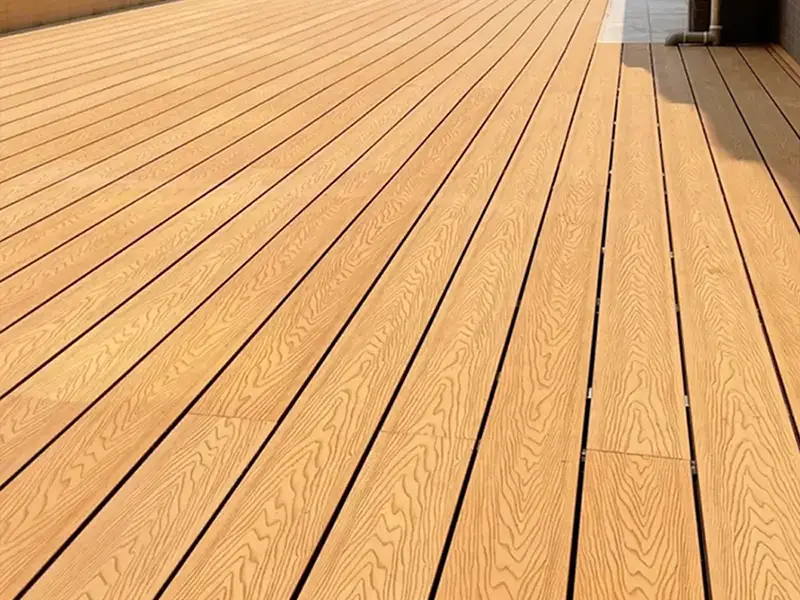
A dry slip resistance rating is meaningless by a pool, bar, or in a rainy climate. You need the wet rating. Look for boards with a high coefficient of friction (COF) when wet, achieved through deeply embossed wood-grain textures or specialized patterns. Your duty of care to the public doesn’t end when it rains.
Fade Resistance: Because First Impressions Are the Only Impression
Your restaurant’s beautiful grey deck turning patchy and brown in a year is a branding disaster. Premium commercial boards use inorganic, ceramic-based UV inhibitors that are integral to the cap, not a superficial coating that washes away. They guarantee minimal color change, often with a 25-year fade warranty. The curb appeal of your property depends on it.
The LEBK Standard: Engineering for the Real World of Commerce
Meeting a standard is one thing. Setting it is another. At LEBK, we engineer our commercial decking boards not just to pass tests, but to exceed expectations in the brutal real world.
From Factory Floor to High-Traffic Zones: The LEBK Process
It starts with a proprietary high-density composite core, engineered for maximum strength and minimum expansion. This core is then seamlessly wrapped in our 360-degree full-cap polymer shield, a formulation developed to resist staining, scuffing, and the sun’s relentless assault. Every batch is tested for load, fade, slip, and flammability. We don’t just sell boards; we sell certainty.
A System, Not Just Boards: Fasteners, Drainage, and Long-Term Integrity
Even the best board can fail if installed poorly. That’s why LEBK provides a complete system: color-matched hidden fasteners for a clean, trip-free surface, and designed drainage channels underneath to promote airflow and drying. This holistic approach is what separates a product from a solution, ensuring the long-term performance required for demanding commercial outdoor applications.
Your Due Diligence Checklist: Vetting Suppliers for Heavy-Duty Decking Boards
Don’t just take a sales rep’s word for it. Arm yourself with these questions:
5 Questions to Ask Before You Specify or Purchase
- “Can I see the third-party test reports for load rating (ASTM D7032) and fire performance (ASTM E84) for this specific profile?” (If they hesitate, walk away.)
- “What is the wet slip resistance coefficient (COF) of this board, and can you provide the test standard used?” (Demand data, not a “it’s slip-resistant” promise.)
- “What is the warranty specifically for fade resistance and stain resistance?” (Look for 25+ years on fade and a strong stain warranty.)
- “Is this a fully capped board or a hollow board? What is the core density?” (Aim for solid/high-density capped boards.)
- “Can you provide contact information for 2-3 similar commercial projects installed 5+ years ago for a reference?” (The proof is in the performance over time.)
Conclusion: Don’t Just Specify Decking, Engineer for Long-Term Value
Specifying commercial decking boards is an exercise in risk management and value engineering. The cheapest upfront cost often carries the highest lifetime price tag in repairs, downtime, and liability. By focusing on the non-negotiables—density, capping, verifiable performance data, and a systems-based approach from a supplier like LEBK—you’re not buying a commodity. You’re investing in a durable, safe, and low-maintenance asset that will support your business and your clients’ businesses for decades. In the world of commercial construction, what’s underneath your feet matters just as much as what’s above your head. Choose a foundation that’s built to last.
Frequently Asked Questions (FAQs)
Q: We’re comparing a high-density capped composite to a tropical hardwood like Ipe. For a heavy-use commercial project, which is actually more durable?
A: This is a classic debate. Ipe is incredibly hard and dense. However, for consistent, low-maintenance commercial performance, a premium capped composite like LEBK’s often wins. Here’s why: Ipe requires regular oiling to maintain color and prevent graying/checking. An uncared-for Ipe deck can become slippery and splinter. A capped composite provides superior, built-in slip resistance (wet and dry), requires zero sealing/oiling, and offers much more consistent color stability with no risk of splintering. The durability of composite is “baked in” and maintenance-free, which is critical for commercial operations.
Q: How important is the fastener system? Can’t we just use standard screws with any commercial board?
A: The fastener system is critically important. Standard screws create water ingress points, can corrode (causing unsightly stains), and create trip hazards. A proper hidden fastener system, like the one provided with LEBK boards, is part of the engineered solution. It allows for thermal expansion/contraction, promotes a clean surface, and often incorporates drainage channels. Using the wrong fastener can void warranties and compromise the entire installation’s longevity. Always use the manufacturer-recommended fastening system.
Q: For a restaurant deck, how do we balance slip resistance with ease of cleaning? Some very textured boards seem to trap grease and grime.
A: An excellent and often overlooked question. The key is in the texture design and the cap formulation. A high-quality commercial board will have a textured surface that provides grip but is not so deep and porous that it traps debris. The polymer cap should be non-porous, allowing spills to be easily wiped or washed away with standard commercial cleaners. When vetting samples, do a simple test: smear a little cooking oil on them, let it sit, and then try to wipe it clean. A good board will clean up easily. Ask your supplier specifically about cleanability.
Q: What’s a realistic expected lifespan for a properly installed, premium commercial composite deck in a four-season climate?
A: With a product like LEBK’s high-density capped composite, properly installed, you should confidently expect a 25- to 30-year functional lifespan. The structural core is designed to resist moisture and freeze-thaw damage, and the cap protects against UV and wear. The limiting factor is rarely the board itself becoming unusable; it’s more often that the aesthetic (color fade) may show slight change over decades. This is why the fade/stain warranty length is such a key indicator of quality.
Q: We manage a large property portfolio. Can commercial composite decking boards be recycled at the end of their very long life?
A: Sustainability is a major advantage. Unlike treated wood, which is a hazardous waste, composite boards from leading manufacturers are often recyclable. The plastic and wood fiber components can be separated and reprocessed into new materials. When evaluating a decking boards supplier like LEBK, ask about their end-of-life or take-back programs. More forward-thinking companies are designing for circularity, allowing you to recover value and meet corporate sustainability goals at the decommissioning stage, making the long-term value proposition even stronger.