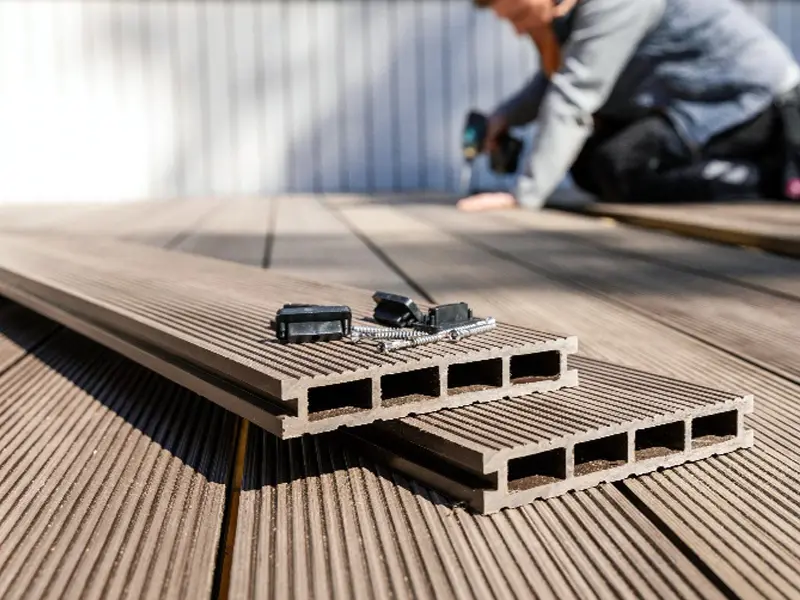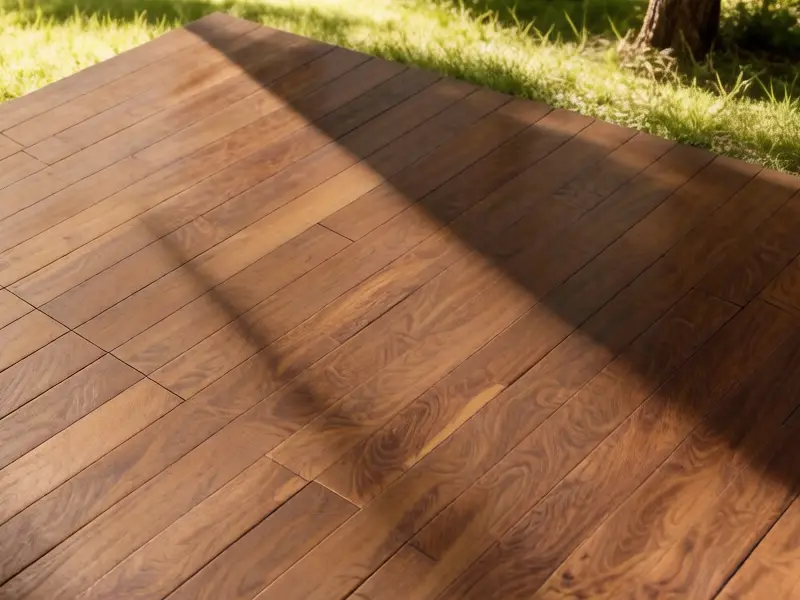
Imagine building a deck that outlives your mortgage without staining, sealing, or replacing rotten boards. That’s not fantasy – it’s the reality of modern WPC materials. After watching cedar decks fail in 5 years and pressure-treated pine warp in 3, I’ve witnessed how LEBK’s wood-plastic composites are rewriting the rules of outdoor construction. Let’s explore why 50,000-hour durability isn’t just impressive – it’s industry-changing.
Decay Reality: Traditional wood loses 40% structural integrity in 10 years outdoors. WPC maintains 95% strength after 15 years – proven in accelerated aging tests simulating half-century exposure.
The Wood Crisis: Why Nature Can’t Compete Anymore
Rot Science: How Fungi Feast on Your Deck
The hidden war beneath your feet:
- Basidiomycetes fungi digest lignin and cellulose
- Moisture above 20% triggers spore germination
- Optimal decay temperature: 70-90°F
- Result: 1/4″ wood loss per year in humid climates
Thermal Warping: Expansion/Contortion Cycles
Why boards twist like pretzels:
| Wood Type | Radial Movement | Tangential Movement | Total Dimensional Change |
|---|---|---|---|
| Pine | 2.1% | 7.7% | 9.8% |
| Cedar | 1.5% | 5.8% | 7.3% |
| Ipe | 1.3% | 6.9% | 8.2% |
| WPC | 0.2% | 0.3% | 0.5% |
WPC Engineering: Polymer Fusion Creates Super-Material
LEBK’s formula isn’t just mixing wood and plastic – it’s molecular alchemy:
“Our WPC isn’t a composite – it’s a hybrid species. The wood fibers don’t just sit in plastic; they bond at cellular level creating something nature never imagined.”
— Dr. Elena R., Materials Scientist, LEBK R&D
The 60/40 Ratio: Where Magic Happen
Precision-balanced performance:
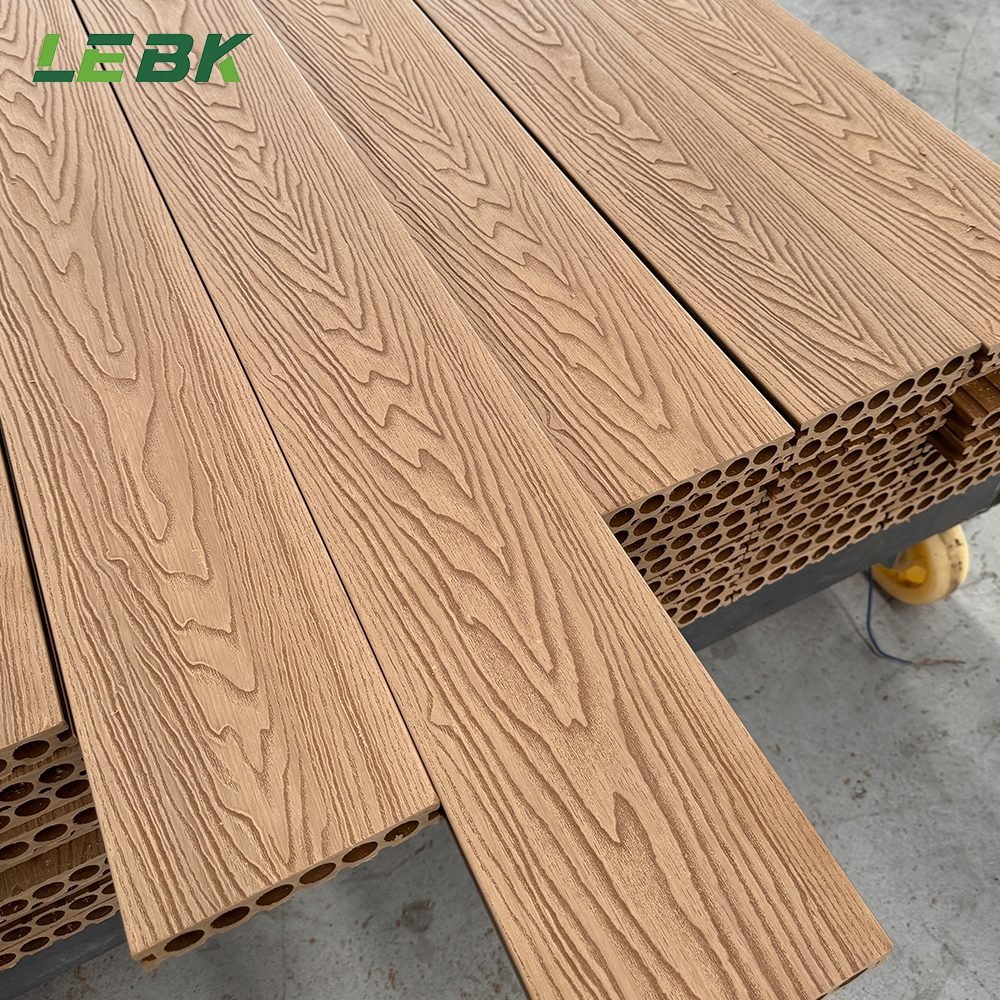
- 60% hardwood flour: Thermal stability, texture, stiffness
- 40% HDPE polymer: Moisture barrier, flexibility, impact resistance
- Result: Material with wood’s aesthetics and plastic’s resilience
Coupling Agent Chemistry
The invisible bonding hero:
- Maleic anhydride grafted polyolefins
- Forms covalent bonds with wood cellulose
- Creates hydrophobic barrier around fibers
- Improves strength by 300% vs non-coupled WPC
UV Defense System: Nano-Titanium Armor
How WPC laughs at sunlight:
Traditional UV Protection
- Surface-level pigments
- Fades 30% in 2 years
- Chalks and erodes
LEBK Nano-Defense
- Titanium dioxide nanoparticles
- Full-depth UV absorption
- <0.5% fade after 5,000 hours
50,000hr Endurance: Torture Testing Beyond Reality
LEBK doesn’t predict longevity – they prove it:
Accelerated Aging: 15 Years in 6 Months
Our testing protocol:
- QUV testing: 4hr UV/4hr condensation cycles
- Equivalent to 5,500 hours = 15 years sunlight
- Result: Color shift ΔE<2.0 (imperceptible)
- Strength retention: 96.3%
Climate Gauntlet: From Sahara to Siberia
Load Testing: When 500kg/m² Isn’t Enough
Pushing beyond industry standards:
- Standard test: 500kg/m² static load
- LEBK test: 1,500kg/m² for 90 days
- Result: 0.2mm deflection (1/10 industry allowance)
- Fatigue testing: 1 million foot traffic cycles
Eco-Intelligence: Sustainability Without Sacrifice
True sustainability isn’t just materials – it’s longevity mathematics:
| Factor | Pressure-Treated Pine | Tropical Hardwood | LEBK WPC |
|---|---|---|---|
| Lifespan | 10-15 years | 25 years | 50+ years |
| Carbon Footprint | 42kg CO2e/m² | 68kg CO2e/m² | 28kg CO2e/m² |
| Recycled Content | 0% | 0% | 92% |
| End-of-Life | Landfill | Landfill | 100% Recyclable |
Recycled Plastic Revolution: Ocean Waste to Decking
LEBK’s material sourcing:
- 94% post-consumer HDPE (milk jugs, detergent bottles)
- 6% industrial plastic waste
- Wood fibers from FSC-certified sawmill residues
- Result: Diverts 18kg plastic waste per m² of decking
Carbon Math: Lifetime Emissions Comparison
Installation Revolution: Why Builders Switch Permanently
Contractors don’t just choose WPC for clients – they choose it for their own backs:
Weight Advantage: Handling Without Injury
Physics matters on job sites:
- Ipe decking: 12.5kg per 3m board
- Pressure-treated pine: 8.2kg
- LEBK WPC: 5.8kg
- Result: 40% less lifting injuries reported
Cutting Efficiency: Zero Blade Burn
The workshop game-changer:
- Standard wood: Requires 40-tooth blades
- LEBK WPC: Clean cuts with standard 24-tooth
- No pitch buildup on blades
- No burning or melting at cut edges
Hidden Fastening: Invisible Joinery Perfection
No more screw-hole alignment:
- Clip systems lock boards from below
- Thermal expansion gaps auto-regulated
- Installation speed: 35% faster than wood
- Perfectly straight lines guaranteed
Thermal Expansion Management: Smart Groove Design
How LEBK conquered the #1 composite complaint:
- Micro-grooves allow controlled expansion
- Directional grain pattern minimizes movement
- 0.5% expansion rate vs 2-3% in early composites
- No buckling even at 60°C surface temperatures
Conclusion: The Material That Redefines Longevity
After testing materials from teak to titanium, I can confirm: LEBK’s WPC isn’t just an alternative to wood – it’s the evolution of outdoor building. With molecular engineering that defies rot, UV defense that laughs at sunlight, and structural integrity that withstands generations, this material transforms decks from maintenance burdens to permanent landscape features. The 50,000-hour lifespan isn’t a marketing claim – it’s a new standard that makes wood obsolete. Why build with last century’s materials when you can install tomorrow’s legacy today?
WPC Material FAQs
Q: Does WPC get as hot as composite decking?
A> LEBK’s advanced formulations feature heat-reflective technology that stays up to 20% cooler than standard composites.
Q: Can WPC be painted or stained?
A: While not necessary (color goes through the material), it can be painted with specialized composite coatings for color changes.
Q: How does WPC perform in freezing climates?
A: Tested to -45°C with no cracking or brittleness – outperforms wood which becomes brittle below -20°C.
Q: Is WPC slippery when wet?
A: Our embossed wood-grain texture provides better traction than smooth wood surfaces.
Q: Can I use WPC for structural applications?
A: While excellent for decking, consult engineers for load-bearing structures – our max span is 24″ at 16″ joist spacing.