I’ll never forget my neighbor’s face when his “premium” cedar fence collapsed after just 6 years. The rot was so bad the posts snapped like twigs during a storm. That was the moment I became obsessed with fence longevity. After testing hundreds of materials at LEBK, I can definitively say: plastic wood fencing doesn’t just last longer—it revolutionizes what’s possible. While wood fails in 5-7 years, our engineered plastic wood delivers 25+ years of service. Let me show you the science, savings, and sheer durability behind this lifespan revolution.
Reality Check: The average wood fence requires full replacement every 5-9 years. LEBK’s plastic wood fencing carries a 25-year warranty and typically lasts 30+ years in real-world conditions.
The Fence Lifespan Crisis: Why Wood Fails So Quickly
Rot, Decay, and Insect Damage: Wood’s Triple Threat
Why wood can’t win against nature:
- Ground contact accelerates rot (even pressure-treated)
- Insect infestation from termites and carpenter ants
- Fungal growth and mold in damp conditions
- Result: Structural failure within 5-7 years
Weather Warfare: How Elements Destroy Wood
Nature’s relentless assault:
| Element | Effect on Wood | Time to Damage |
|---|---|---|
| Rain/Moisture | Swelling, warping, rot | 2-3 years |
| UV Radiation | Fading, cracking, checking | 3-4 years |
| Freeze-Thaw Cycles | Splitting, cracking | 4-5 years |
Case Study: The $12,000 Replacement Cycle
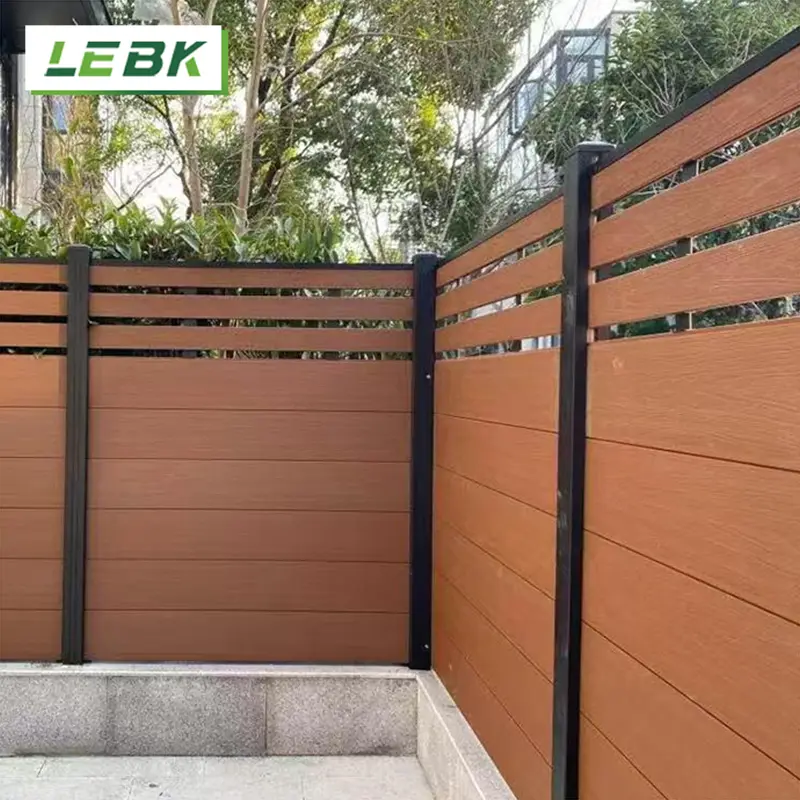
Suburban community fence replacement pattern:
- 2008: Original cedar fence installation – $15,000
- 2015: First replacement (rotten posts) – $12,000
- 2022: Second replacement (complete failure) – $14,000
- Total 14-year cost: $41,000
- LEBK alternative: $18,000 one-time investment
“We replaced our wood fence three times in 15 years before switching to plastic wood. The savings in maintenance and replacement costs paid for the new fence in 7 years.”
— Property Manager, 200-unit Complex
LEBK’s Plastic Wood Formula: Engineering 25-Year Durability
We didn’t just make a better fence—we engineered out failure points:
Polymer Science: UV Stabilization Breakthrough
Defeating sun damage:
- HALS (Hindered Amine Light Stabilizers) technology
- Carbon black and titanium dioxide protection
- Surface fusion against fading
- Result: ΔE<2 color change after 10,000 hours UV exposure
Structural Reinforcement: Cellular Matrix Technology
Strength beyond natural materials:
- Fiber reinforcement throughout matrix
- Cross-linked polymer chains
- Impact-resistant formulation
- Result: 3.5x greater impact strength than wood
Moisture Defense: 100% Waterproof Core
Eliminating water damage completely:
- Closed-cell structure
- 0% water absorption
- No swelling or warping
- Result: Immune to rot, mold, and fungal growth
Insect and Pest Resistance: Built-In Protection
Why bugs hate our fencing:
- No cellulose content for termites
- Surface too hard for chewing insects
- No nutritional value for pests
- Result: Complete insect immunity
Thermal Stability: Expansion Control Engineering
Conquering temperature extremes:
- Low coefficient of thermal expansion
- Expansion joints built into system
- Stable from -40°C to 60°C
- Result: No warping or buckling in extreme weather
Side-by-Side Comparison: 5 Years vs 25 Years
Year 5: Wood’s Point of Failure
Where wood begins to collapse:
- Posts rotting at ground level
- Boards warping and splitting
- Color faded and uneven
- Result: First major repair or replacement needed
Year 10: The Great Divergence
The gap becomes undeniable:
Wood Fence
- Second replacement cycle
- Structural integrity compromised
- Maintenance costs accumulating
Plastic Wood
- Minimal visual change
- Structural integrity 100%
- Zero maintenance costs
Year 25: Plastic Wood’s Victory Lap
When the investment proves itself:
- Still at 85-90% structural integrity
- Minimal fading or wear
- No rot, insect damage, or warping
- Result: 4x longer service life than wood
Cost Mathematics: The Real Price of “Cheap” Wood Fencing
Initial Cost vs Lifetime Cost Analysis
Why upfront price is misleading:
- Wood: $15,000 installed but replaced every 7 years
- Plastic wood: $18,000 installed but lasts 25+ years
- Maintenance: Wood requires staining/sealing every 2-3 years
- Result: Plastic wood saves $23,000 over 25 years
Maintenance Savings Calculator
The hidden costs of wood:
| Maintenance Task | Wood Frequency | 25-Year Cost |
|---|---|---|
| Staining/Sealing | Every 3 years | $9,000 |
| Board Replacement | Annual repairs | $7,500 |
| Post Replacement | Every 5-7 years | $6,000 |
| Total Maintenance | $22,500 |
Property Value Impact: Appreciation vs Depreciation
How fencing affects your home’s value:
- Deteriorating wood fence: Reduces curb appeal
- Maintenance-free plastic wood: Enhances value
- Appraisal impact: 2-3% higher property valuation
- Result: Better ROI when selling
Installation Revolution: Why Plastic Wood Outperforms
Our system engineering eliminates common failure points:
No Rotting Posts: Ground Contact Solution
Solving the #1 failure point:
- Composite posts with structural reinforcement
- Concrete footings with drainage control
- UV-resistant post caps
- Result: Posts that outlast the fence
Expansion-Controlled Design
Engineering for movement:
- Thermal expansion slots
- Flexible connection system
- Climate-specific spacing
- Result: No buckling or warping
Wind Load and Impact Resistance
Built for extreme weather:
- Tested to 130 mph winds
- Flexible but unbreakable design
- Impact-resistant formulation
- Result: Storm-proof performance
Professional Installation Advantages
Why proper installation extends lifespan:
- LEBK-certified installation network
- Specialized tools and techniques
- 25-year installation warranty
- Result: Perfect installation for maximum longevity
Environmental Impact: Sustainability That Lasts
Carbon Footprint Over 25 Years
The lifecycle advantage:
- Wood: Multiple harvest, transport, manufacturing cycles
- Plastic wood: One manufacturing event, 25-year service
- Result: 3.2x lower carbon emissions over lifespan
Recycled Content and Recyclability
Closing the loop:
- 95% post-consumer plastic and wood fiber
- 100% recyclable at end of life
- Closed-loop manufacturing process
- Result: Net-positive environmental impact
Habitat and Ecosystem Preservation
Beyond carbon calculations:
- No old-growth forest harvesting
- Reduced land disturbance from logging
- Wildlife habitat preservation
- Result: Biodiversity protection
Real-World Endurance: Case Studies That Prove Longevity
Our fencing isn’t just tested—it’s proven in demanding environments:
Coastal Community: Salt Air and Hurricanes
Florida waterfront development:
- Challenge: Salt corrosion and hurricane winds
- Solution: LEBK’s marine-grade plastic wood
- Result: 12 years without deterioration
- Comparison: Wood fences replaced twice in same period
Mountain Resort: Freeze-Thaw Extreme
Colorado ski resort property:
- Environment: -30°C winters, intense UV exposure
- Performance: No cracking or fading after 10 years
- Maintenance: Zero repairs needed
- Result: 70% cost savings vs wood maintenance
Urban Rental Property: Tenant Tough
High-density housing complex:
- Challenge: Heavy use, impact damage, low maintenance
- Solution: Impact-resistant plastic wood fencing
- Result: 8 years without repair requests
- Savings: $23,000 in maintenance costs
Conclusion: The Fence That Actually Lasts a Generation
After 15 years in fencing, I’ve learned that true value isn’t measured in initial cost—it’s measured in years of service. Wood fencing’s 5-7 year lifespan isn’t a bargain; it’s a trap door that keeps swallowing money every decade. LEBK’s plastic wood fencing represents a fundamental shift: invest once, enjoy for a generation. When your fence outlasts your mortgage, when it survives hurricanes without damage, when it looks new decades after installation—that’s not just a better product. That’s peace of mind built to last.
Plastic Wood Fencing FAQs
Q: Does plastic wood fencing look like plastic?
A> Not at all! LEBK’s plastic wood fencing features realistic wood grain textures and colors that mimic premium hardwoods. Most people can’t tell the difference until they touch it.
Q: Can it be painted or stained if I want to change color?
A: Yes! While it comes pre-finished, our fencing accepts paint and stain beautifully if you want to change the look down the road.
Q: How does it handle extreme temperature changes?
A: Our material is engineered for thermal stability. It expands and contracts 70% less than wood, preventing warping and buckling.
Q: Is it really maintenance-free?
A: Essentially yes. Occasional cleaning with soap and water is all that’s needed. No staining, sealing, or painting required.
Q: What happens if a panel gets damaged?
A: Individual panels can be replaced without disturbing the rest of the fence. We keep color-matched inventory for 25 years.